
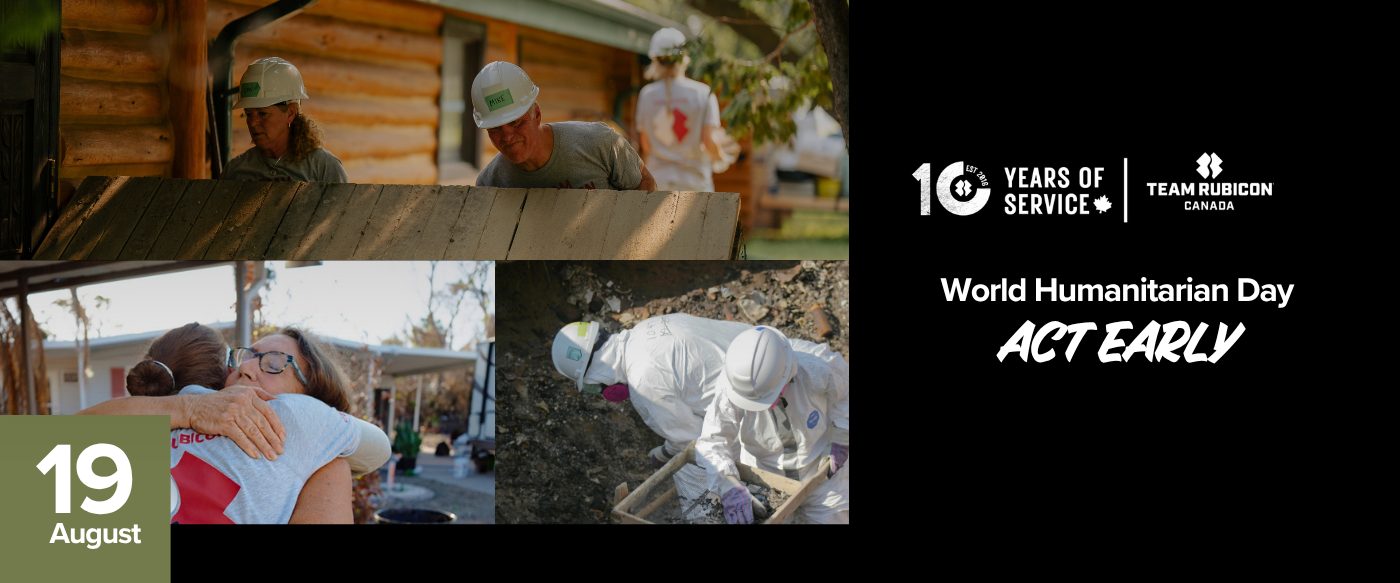
Act Early: What Ten Years of Team Rubicon Canada Says About Humanitarian Readiness
Every August 19, the world observes World Humanitarian Day. Established by the United Nations following the 2003 Baghdad bombing that killed 22 aid workers, the day recognizes the people who serve communities in crisis and the risks they carry to do it. This year’s theme is a call to act before disaster becomes tragedy — before warning signs become casualty lists.
That principle isn’t unique to conflict zones, but the same logic behind wildfire mitigation, flood preparedness or other national hazards. A decade of work Team Rubicon Canada has built around it.
Ten years, one mission
Team Rubicon Canada’s story started in 2016, when wildfire tore through Fort McMurray, Alberta, displacing more than 88,000 people. Within days, a small group of volunteer veterans, first responders and kick-ass civilians mobilized alongside international Greyshirts to help residents sift through the ashes and begin recovering what they could. That first mission became the foundation of an organization that, ten years later, counts nearly 5,000 trained volunteer Greyshirts from coast to coast to coast.
In the years since Fort McMurray, Greyshirts have responded to floods, hurricanes, tornadoes, severe weather and wildfires. They stood up support during the COVID-19 pandemic. They deployed to Jasper, Alberta, in 2024 when wildfire changed the town overnight. This year, we’ve responded to flooding in Manitoba and Ontario. Each operation added to a body of made-in-Canada training that has become a benchmark for how volunteer disaster response is done in this country.
Why “act early” matters here too
World Humanitarian Day’s 2026 message — act before warning signs become casualties — describes exactly what Team Rubicon Canada has spent a decade building toward. Long before a potential wildfire can inflict damage, Greyshirt sawyer teams perform mitigation efforts, removing hazardous trees and clearing brush to reduce fuel loads. Long before flood waters hit, volunteers are deployed to lay sandbags. Disaster response isn’t only what happens after the emergency; it’s readiness built in the blue skies before it.
That’s the example Team Rubicon Canada’s first ten years has set: showing up when Canada needs it, and doing the quieter work in between so the response is faster and safer when the next disaster comes.
What’s next
With climate-driven disasters growing more frequent and severe, the need for trained, deployable volunteer Greyshirts is only increasing. Team Rubicon Canada’s next decade is focused on building that readiness at scale — training more Greyshirts, strengthening partnerships with provincial and federal emergency management, and making disaster mitigation as much a part of the mission as disaster response.
On this World Humanitarian Day, Team Rubicon Canada is remembering humanitarian workers around the world who serve others during disaster or crises, and marking ten years of Canadians who chose to give of their time by being ready to respond long before they arrive.
Are you interested in becoming a Greyshirt? Sign up today!