
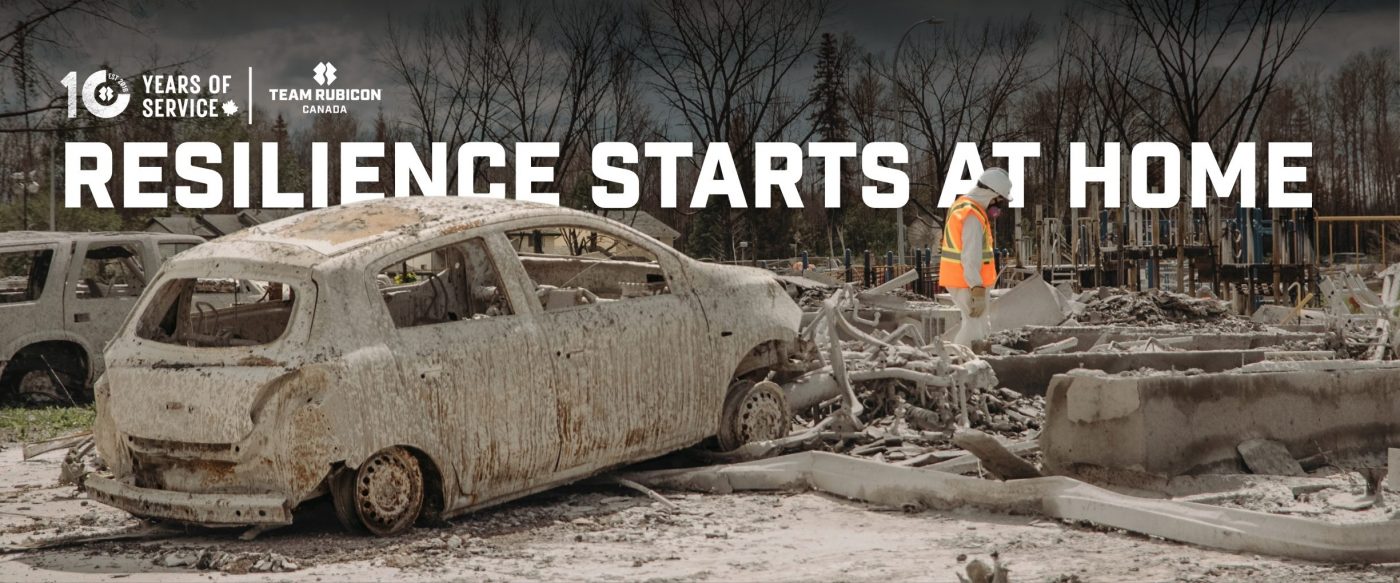
Resilience Starts at Home
This October 13 marks International Day for Disaster Risk Reduction, and this year’s theme, “Resilience Starts at Home,” couldn’t land closer to where we’ve built our organization. Home is where disaster hits hardest and where recovery has to begin. It’s also where Team Rubicon Canada’s story in this country started: ten years ago, in Fort McMurray.
In April, Susan Penwarden, Managing Director of Personal Lines at Aviva Canada, wrote in The Hill Times about what that decade has taught us. Her assessment is blunt: Canada is the only G7 country without a national disaster relief agency, and the disasters keep coming faster than our systems can absorb them. Since Fort McMurray, we’ve watched Jasper, Lytton, and Kelowna try to match its scale. Eight of the worst wildfire years on record have happened in the last ten. Aviva’s own data shows wildfire claims up roughly 1,900 per cent over the past five years compared with the five before that, and insured wildfire losses up tenfold since Fort McMurray itself. Numbers like that describe a pattern, not a run of bad luck.
Penwarden’s piece calls for a coordinated, whole-of-society response: a national emergency management strategy, sustained investment in climate adaptation, and building codes that reflect the climate we actually live in now — not the one we used to. It’s a case for exactly the kind of partnership we’ve built with Aviva Canada over these ten years, and one they’ve now backed with real investment.
In January, Aviva Canada announced $250,000 in new funding to TR Canada to strengthen how we prepare for and respond to disaster across the country. The funding goes directly into the things that make a response fast and capable: training and deploying our volunteer workforce — more than 4,300 Greyshirts, veterans, first responders, and skilled civilians who show up when communities need them — along with mitigation and preparedness work designed to soften the impact before disaster strikes and speed recovery after. Aviva employees are also getting hands-on volunteer opportunities alongside TR Canada missions, and the two organizations are working together on advocacy to push for a stronger, more coordinated national disaster system.
“With severe weather becoming a defining challenge for communities, our focus must remain on protecting Canadians and building resilience,” Penwarden said of the partnership. “By pairing immediate relief with long-term preparedness, we can make a meaningful difference for Canadians facing the growing impacts of severe weather events.”
Mischa Kaplan, TR Canada’s CEO, put it in the context of the anniversary: “As we mark 10 years of service to Canadian communities, Aviva’s investment allows us to better prepare our volunteers, respond more quickly when disasters strike, and work toward a more coordinated and resilient disaster response system across Canada.”
That’s what this partnership looks like on the ground — not just funding on a page, but training, deployments, and people showing up for each other before, during, and after disaster.
IDDRR’s 2026 call to action lands on governments, the private sector, and households alike. Aviva’s investment is what that call looks like when a private-sector partner actually answers it — pairing insurance expertise with operational capability instead of leaving the two to work in isolation. Ten years after Fort McMurray, that’s the kind of collaboration our system still needs more of, and it’s the kind we intend to keep building.