
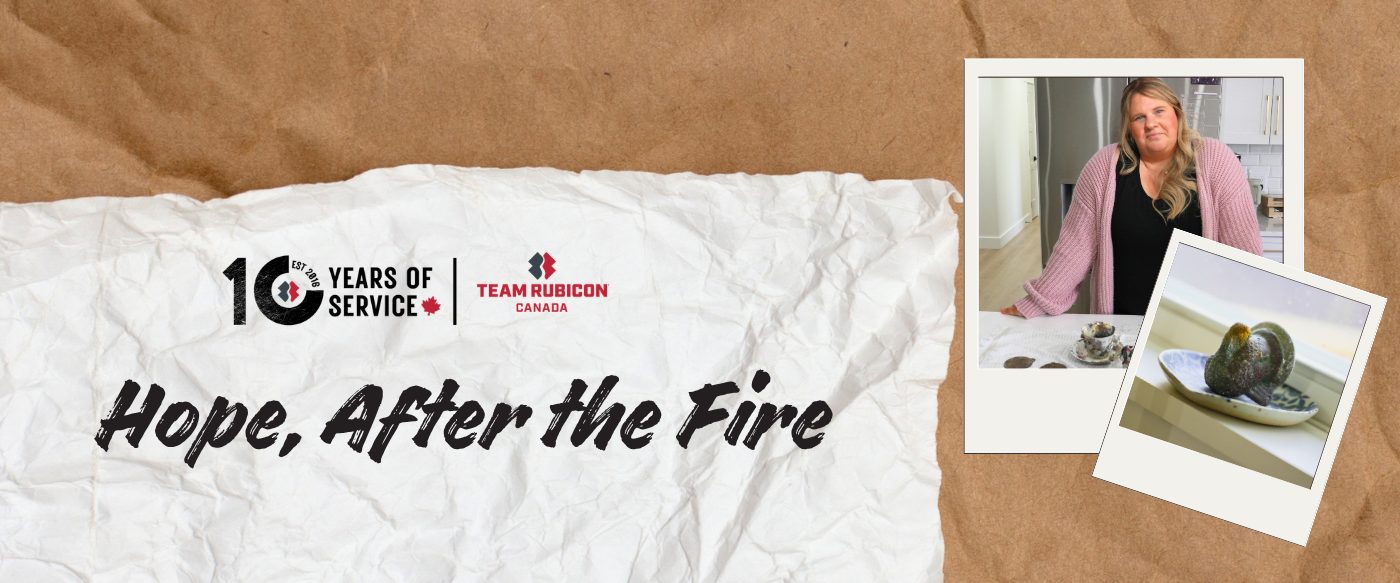
Hope, After the Fire
By the time Jenny Saulnier noticed how close the fire had gotten, it was already behind her house.
“I walked down the hallway and I looked to my right, and there were red flames in my backyard,” she said. “That’s when I was like, ohh, this is it. I got to go.”
There wasn’t the time to think through what to take. She moved quickly, grabbing what she could into bags, then loading them into her truck with her dog, going back and forth until the smoke made it impossible to see and even harder to breathe, and she had to go.
Jenny thought the fire was across the lake, still in Tantallon, NS, and not already moving through her own neighbourhood.
“I didn’t realize it was here in our community,” she said. “I could hear the water bombers getting quite close to our home. And that’s when the panic set in because it sounded like bombs dropping. That’s way too close, I thought, so I went and started packing to leave this situation.”
The fire had spread throughout the neighbouring area by the time she drove off.
“It’s almost like if you picture a volcano erupting and it’s throwing the ash or the lava. We see all the little things on fire like you’d see in a movie. And I was just driving through it. It felt like a horror scene. It was a scary day for me.”
Fires burning in the ditches and behind her, visible from her rear view mirror, embers falling across the road.
Jenny recalls that when she lost her home, she didn’t just lose the house, the walls. She could take all that. “The items and the sentimental things inside my home,” she stated. “The childhood ornaments, hockey medals, coin collections, now one day we don’t get to pass them on to our grandkids. One day we don’t have anything to give our child from his childhood to take with him when he builds a family.”
In the days that followed, Team Rubicon Canada volunteers moved through what used to be her home. They searched carefully, sifting and sorting through the ashes for what the fire had left behind, looking for anything that could still be salvaged.
For Jenny, it was the first moment since leaving that something felt possible again.
“They gave me hope that we could come out of this,” she said. “Take what we could from this experience with Team Rubicon Canada and move forward.”
A few pieces of their life were still there, teacup from her aunt, a small ceramic ornament her son had made, some of his coin collection, a turkey salt and pepper shaker that once belonged to her great grandmother.
“It was still fully looking like a turkey. It was a little grey and a little spotted, but it still looks like a turkey,” she said. “It’s our little sign of hope that we’re here and we’re okay.”
As the shock began to settle, what stayed with her most was who showed up. Kick-ass volunteers stepped in, offering their time without being asked, they stayed, working long days to help people start again.
“I could not believe when I heard that the members of Team Rubicon Canada, all these volunteers, came here. They don’t get paid to do what they’re doing. They’re literally doing it out of the goodness of their hearts,” she said. “They slept on cots in our legion. They pushed and pushed and pushed and kept coming up, waking and getting up for the people, out here for us as a community to try to lift us up in the way that they could.”
Getting those pieces back didn’t undo what was lost, but it changed what came next. “They gave me hope. It was a stepping stone for us to be able to get what we could of our home, and we knew that somebody could come and do it safely and efficiently,” Jenny said.
“Then we knew that we could close the chapter on our home and move forward until we could come back to this place and call it home.”
Jenny has discovered hope and resilience despite unspeakable loss. Taking hold of the little gems that survived the fire.
“They were like angels that come up from the earth and come to help other people. It brings me so much joy talking about Team Rubicon Canada,” Jenny said.
Before It Happens
Most days, emergency plans sit untouched.
They live in the back of a drawer, saved in the notes app or exist only as something people mean to get to eventually. Life feels normal, and preparation doesn’t feel urgent.
Until it is.
A storm shifts direction. The power goes out. Roads close faster than expected. In those moments, there’s no time to figure things out from the beginning. People aren’t thinking about what they planned to do, they’re thinking about what they have, who they can reach, and what happens next.
Across Canada, communities face disasters each year that disrupt daily life in an instant. Floods, wildfires, and severe storms can change the course of a day, or a season, without much warning. What happens in the first few hours often depends on the level of preparation already in place.
For individuals and families, preparedness can start small.
It might look like having clean water and non-perishable food set aside. It might mean knowing where important documents are stored, or having a plan for where to go if it’s not safe to stay home. These are quiet decisions, made on ordinary days, that carry weight when something goes wrong.
Preparedness is not only personal. It shapes how communities respond as a whole.
When more people are ready, there’s less confusion in the early moments of a disaster. There’s more capacity to check on neighbours, support those who need help, and reduce the strain on emergency services.
For Team Rubicon Canada, that readiness is part of the work long before a disaster ever reaches a community.
Greyshirts train in advance, building the skills needed to respond in uncertain conditions. They learn how to move quickly, how to adapt, and how to work alongside communities when the situation is still unfolding. That preparation allows teams to arrive with purpose and begin supporting recovery without delay.
The work that follows often reflects what came before.
A clear plan can mean faster decisions. A prepared household can mean one less emergency call. A community that understands its risks can recover with more stability in the days ahead.
It’s easy to think that disasters are very far away or improbable. that they will occur to someone else and somewhere else, but when they do, everyone asks the same question of everyone involved.
Are you prepared?
Team Rubicon Canada Greyshirts are veterans, first responders, and kick-ass civilians who volunteer their time to serve communities before, during and after a disaster, but their ability to respond and get into the field depends on donor support. Training, equipment, deployment happens when people who believe that people like Jenny shouldn’t face disaster alone.