
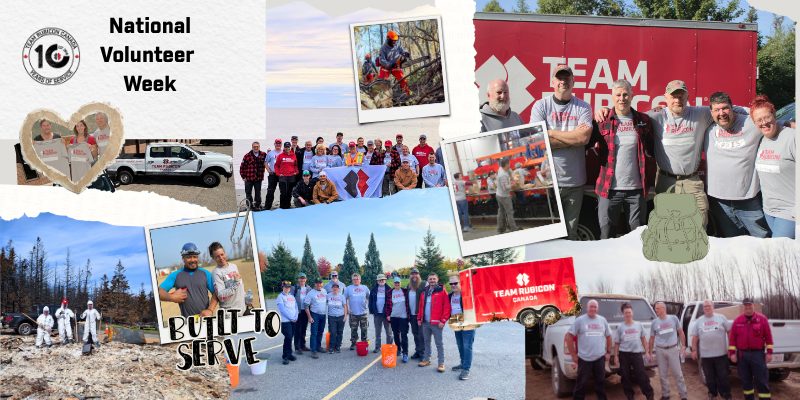
The Spark Behind Every Mission Is a Person Who Showed Up
Much of the work behind a Team Rubicon Canada deployment happens out of sight, long before crews arrive and long after they leave.
While the organization is known for disaster response, many volunteers contribute well beyond what is visible on the ground. Their roles may not always be seen, but they are essential in making each response possible. For volunteers, that work isn’t just about logistics but also about showing up for each other.
“When people picture Team Rubicon Canada, they picture chainsaws, sifting and mucking out homes, and that’s part of it,” said Colette Ainsworth, Manager of Volunteer Experience. “But the truth is, most of the work happens before and after those moments.”
Ainsworth said many Greyshirts support operations from behind the scenes, helping with onboarding of other volunteers, organizing and maintaining equipment, coordinating travel and checking in with team members ahead of deployments.
“They’re onboarding new members, calling folks to check if they’re okay to deploy, organizing gear, coordinating travel, supporting training, or just being that steady voice when someone needs guidance,” she said.
She recalled Greyshirts in Atlantic Canada spending hours preparing teams ahead of a storm response.
“That work doesn’t make the news, but without it, the response doesn’t happen,” Ainsworth said. “It’s all one system.”
That sense of collective effort carries into the field, where Greyshirts often find themselves working in communities experiencing loss and uncertainty.
After Hurricane Fiona in 2022, Greyshirt volunteers were deployed to rural and coastal areas in Cape Breton and Prince Edward Island, where help could take longer to reach.
“There was a homeowner who had been waiting days just to get a fallen tree off their property,” Ainsworth said. “It wasn’t just about the tree; it was about feeling forgotten.”
When Greyshirts arrived, they cleared the debris, but Ainsworth said the impact went beyond the physical work.
“They took the time to talk, to listen to the homeowner,” she said. “You could see the shift. It wasn’t just relief, it was connection.”
At the same time, she saw Greyshirts supporting each other after long days on site.
“I watched them at the end of long days, tired, soaked, sometimes carrying what they’d seen, but still checking in on each other,” she said. “Sharing a meal, making sure no one was sitting alone with it.”
That kind of support is rooted in the organization’s culture, which Ainsworth described as people showing up for one another.
“We have people from all walks of life, but when they’re here, titles don’t really matter,” she said. “What matters is that you’re willing to contribute and look out for the person next to you.”
She said that culture is built through small, consistent efforts, both in the field and behind the scenes. In her role, Ainsworth focuses on the full volunteer experience, from recruitment to ongoing support.
“For me, membership is about the full journey: how we find people, how we welcome them, how we support them, and how we make sure they have a meaningful place here,” she said.
Her day-to-day work includes improving the sign-up process, supporting training and listening to feedback from volunteers to better understand what is working and what could be improved.
“It’s really about the small, consistent things and making sure people feel like they belong, and that they matter within our organization,” she said.
That sense of belonging is especially important given the nature of the work. Volunteers are often placed in high-stress environments where they are supporting people through difficult moments.
Training, including Mental Health First Aid, plays a key role in preparing volunteers for those situations.
“It’s essential,” Ainsworth said. “The work we do puts volunteers in environments where others have experienced real loss and that has an impact.”
She said the training gives volunteers practical tools to recognize when someone may be struggling and how to respond appropriately.
“But just as important, it helps volunteers look out for each other,” she said. “Because sometimes it’s not the homeowner who’s having a hard day, it’s the Greyshirt beside you.”
As National Volunteer Week highlights the contributions of volunteers across the country, Ainsworth said there’s a place for anyone who wants to get involved.
“I’d say you don’t have to fit any type of mold to be here,” she said. “There’s a role for everyone.”
She said many people hesitate to join because they feel they lack the right skills, but the organization provides opportunities to learn and grow.
“If you care about people, if you’re willing to learn, and if you want to be part of something greater than yourself, you’re already at the right place,” she said.
For Ainsworth, the impact of volunteering isn’t just measured in the work completed, but in the connections formed along the way.
“You start a deployment sometimes not knowing a soul,” she said. “By the end of the week, those strangers are part of your family.”