
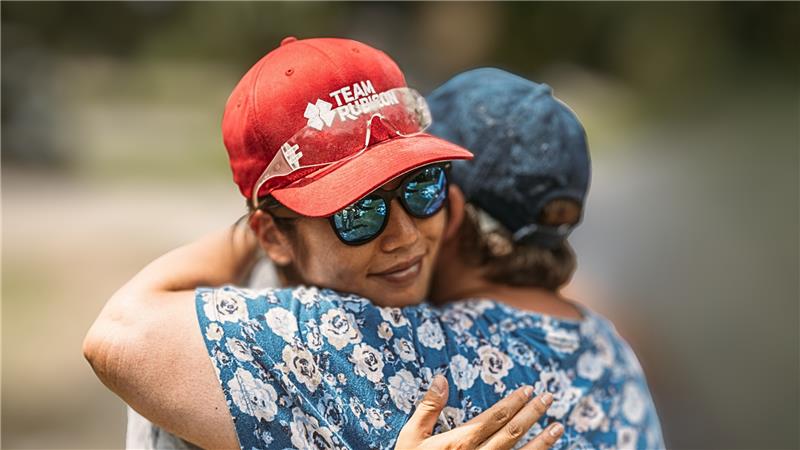
Humanity is the Heart of Humanitarian Work
When the United Nations chose “It Takes a Village” as this year’s theme for World Humanitarian Day, they captured something fundamental about disaster response: recovery isn’t just about logistics, equipment, and technical skills. Rather, it’s about people standing with people when they need it most.
Greyshirts are experiencing this truth firsthand in Manitoba, where wildfires forced entire communities from the province’s north to evacuate, leaving families uncertain about when—or what—they’ll return to.
Beyond the Chainsaw: A Different Kind of Service
For many of our Greyshirts, this deployment is different from what they’ve come to expect. There are no hazardous trees to clear, no ash-filled foundations to sift through, no water-damaged homes to muck out. Instead, the mission is simpler and, in many ways, more complex: to support displaced people and the agencies helping them, filling gaps wherever we can.
“We are here to assist and work with those who have been evacuated and impacted by the wildfires in northern Manitoba,” explains Greyshirt Peter Ensor, who served as team lead for the first wave of the Winnipeg-based operation. “We are trying to make their lives a little bit better during this difficult time until they can get back to their communities and lives, hopefully, sooner rather than later.”
For Greyshirt Spring Noganosh, it was her first deployment with Team Rubicon Canada. “I didn’t know exactly what to expect,” she admits. “I prepared as best I could, ready with gear I thought I would need, wondering what the schedule might look like. But you can’t fully prepare for the human part until you’re in it.”
The Weight of Displacement
For people forced from their homes, displacement is about more than losing access to familiar spaces. It’s emotional upheaval, a sense of loss, the feeling of being cut off from community, from the small daily anchors that make life feel normal, or from the places that define home and identity.
Displacement can happen to anyone, anywhere. Whether it’s wildfire, flooding, or severe weather, the experience of suddenly being separated from everything familiar carries the same weight. People find themselves in unfamiliar places, navigating systems they don’t know, wondering about the future while trying to manage the present.
Service Beyond the Task List
Team Rubicon Canada’s work in Manitoba reminds us that sometimes the most important thing we can do is simply show up. While our Greyshirts organized supplies at reception centres and helped families navigate available resources, the deeper impact comes through presence itself—being there to remind people that they’re not facing this alone.
“We are here to do whatever it takes to help them during their time here,” Ensor says, capturing the commitment that drives every Greyshirt deployment. “Operations like this remind you that humanitarian work is more than the visible action. Sometimes the most important thing is to be there and show someone they matter enough for you to spend your time assisting them.”
This is what humanitarian work really means. “Recognizing that behind every disaster statistic is a human story,” explains Colette Ainsworth, Manager of Volunteer Experience. “Every evacuee, or home sifted, or dollar spent represents someone whose life has been impacted, whose sense of security or future was upended, or whose children are asking questions that don’t have easy answers.”
A Village That Stretches Coast to Coast
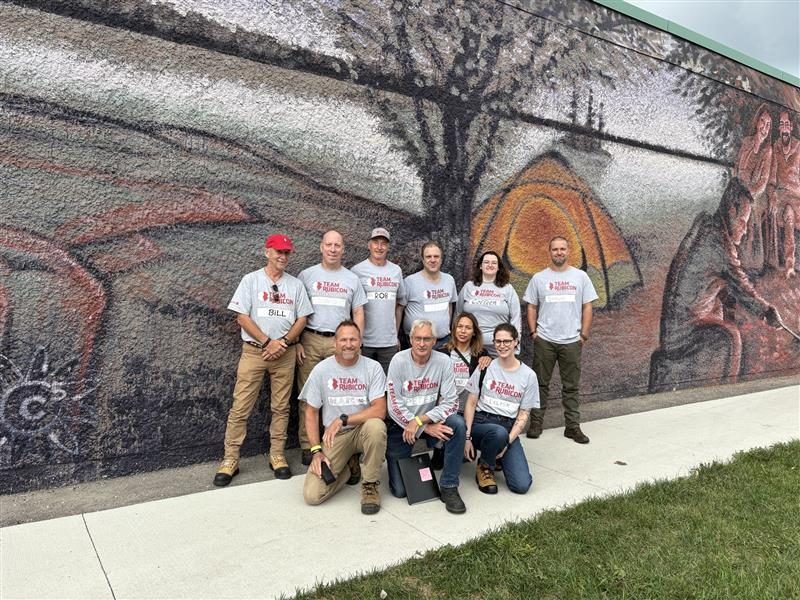
Greyshirts came to Manitoba from British Columbia, Ontario, and even the Maritimes. Some had been on multiple deployments; others, like Spring, were stepping into the field for the first time. What they share is a commitment to service and the belief that showing up matters.
“The second you put on that Greyshirt,” explains Spring, “you’re part of something bigger.” That “something bigger” extends far beyond any single operation. It’s a network of Canadian volunteers who train year-round, stay ready to deploy, and carry not just their technical skills and experience, but their humanity into communities facing their worst days.
Team Rubicon Canada trains Greyshirts in hazard mitigation, debris management, and incident coordination. But there’s another capability that’s harder to measure, and that is empathy. In Manitoba, empathy meant slowing down enough to understand that behind the practical needs—shelter, food, information—are deeper human needs.
Why It Matters
Every operation ends eventually. The Greyshirts will eventually pack up, return to their own communities, and prepare for whatever comes next. But for the people they serve, the recovery continues long after the last truck pulls away.
Greyshirts carry their experiences with them. “It changes them,” states Ainsworth, who has been working with Greyshirts for more than five years. “They start wanting to help others, and they leave realizing those they have helped have given them something too—the reminder of why helping others matters.”
This World Humanitarian Day, we honour not just the responders, but the spirit of humanity that drives them. Disasters may be unpredictable, but the choice to show up, to offer time, skills, and compassion, is always within our control.
In Manitoba, and other operations that Team Rubicon Canada currently has underway, that choice means people impacted by disaster don’t have to face their worst days alone. It means someone is there to stand beside them, and to remind them that even in uncertainty, they are part of a larger community that cares.
“Humanitarian work is about people first,” Ainsworth says. “If you forget that part of the story, you miss the point. Every task, every mission, all comes back to the human need.”
And that’s the village we’re building, one operation at a time.
Learn more, volunteer, or support our mission at TeamRubicon.ca